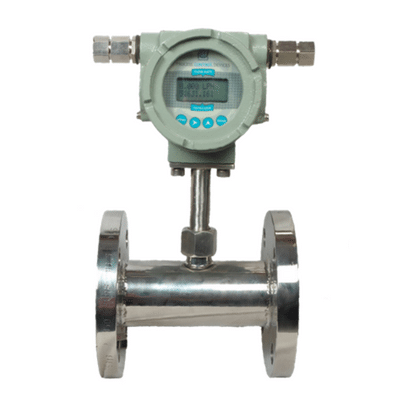
Turbine Flow Meter
A turbine flow meter is a precision-engineered device used to measure the flow rate of clean liquids in industrial flow measurement applications. It operates on the principle of a rotating turbine placed in the fluid stream, where the rotational speed is directly proportional to the flow velocity.
Overview
A turbine flow meter is a precision-engineered device used to measure the flow rate of clean liquids in industrial flow measurement applications. It operates on the principle of a rotating turbine placed in the fluid stream, where the rotational speed is directly proportional to the flow velocity.
This industrial turbine flow meter from a trusted turbine flowmeter manufacturer is widely used due to its high accuracy, repeatability, and durability, making it ideal for applications involving water, chemicals, light oils, and other low-viscosity fluids.
Designed for reliable pipeline installation, the meter provides stable performance even under varying pressure and temperature conditions. The advanced sensing mechanism converts turbine rotation into electrical signals, which are then processed to display accurate flow readings.
Our high accuracy turbine flow meter for oil and gas applications offers reliable performance, minimal maintenance, and long operational life, making it suitable for industries like water treatment, oil & gas, chemical processing, and manufacturing.
Features
- High accuracy (up to ±1%)
- Suitable for clean liquid applications
- Low pressure drop
- Pulse and analog output options
- Compact and rugged design
- Easy installation and maintenance
- Stable performance in industrial conditions
BENEFITS
- Accurate and reliable flow measurement
- Improves process efficiency and control
- Low maintenance requirement
- Long service life
- Easy integration with systems
- Cost-effective solution for industries
Specifications
Mechanical Specifications
| Parameter | Specification |
|---|---|
| Line Size | 15 NB to 150 NB |
| Turbine Rotor | SS 410 |
| Pipe MOC | SS 304 / SS 316 |
| Design Temperature | Up to 150°C |
| Connection | Flanged (ASA / BS), Screwed, TC |
Electronics Specifications
| Parameter | Specification |
|---|---|
| Programming | By membrane keypad |
| Power Supply | 24 VDC (Isolated), 230 VAC, 110 VAC |
| Outputs | 4–20 mA, 4-wire, Pulse |
| Communication | RS 485 Modbus |
| Accuracy | ±1% of FSD (±0.5% on request) |
| Linearity | ±0.5% |
| Repeatability | ±0.5% |
Transmitter Specifications
| Category | Specification |
|---|---|
| Display | Character LCD Display |
| Display Parameters | Flow rate & totalizer |
| Electronics | Microprocessor based |
| Configuration | Via keypad |
| Analog Output | 4–20 mA |
| Communication | RS 485 Modbus RTU |
| Power Supply | 24 V DC |
| Cable Entry | 1/2" NPT (F) |
| Enclosure | IP65 / IP67 / Flameproof (optional) |
| Approval | PESO (if required) |
Process Parameters
- Fluid: Liquids
- Specific Gravity: Up to 2.95
- Viscosity: Up to 100 cP
- Design Pressure: Up to 100 kg/cm²
- Measuring Range: 0.2 to 350 m³/hr
Working Principle
The turbine flow meter operates on a simple and reliable concept of converting fluid flow energy into rotational motion. The core mechanical assembly consists of a precision turbine rotor, designed with an aerodynamic shape and made from magnetic material to ensure efficient energy conversion.
As the liquid flows through the pipeline, it strikes the turbine blades, causing the rotor to spin. The rotational speed of the turbine rotor is directly proportional to the velocity of the fluid, enabling accurate flow rate measurement.
The rotor shaft is supported by tungsten carbide bearings, which provide high durability, reduced friction, and long operational life, even under continuous industrial use.
A magnetic pickup sensor, mounted externally without penetrating the meter body, detects the rotation of the turbine. This sensor consists of a magnet and coil arrangement that senses the change in the magnetic field as the rotor blades pass by.
Each rotation generates a pulse signal, producing a frequency output proportional to the flow rate. This signal is then processed by the electronics to calculate and display:
- Instantaneous flow rate
- Totalized flow volume
The output can be easily converted into standard engineering units such as m³/hr, liters, kilograms, tons, and cubic feet, making it suitable for industrial flow measurement applications, including oil & gas, chemical processing, and water systems.
Available Options
Testing
Why Turbine Flow Meter
Testing
Frequently Asked Questions
Get a Technical Quote
Tell us your application requirements and our engineers will specify the right configuration.